Program
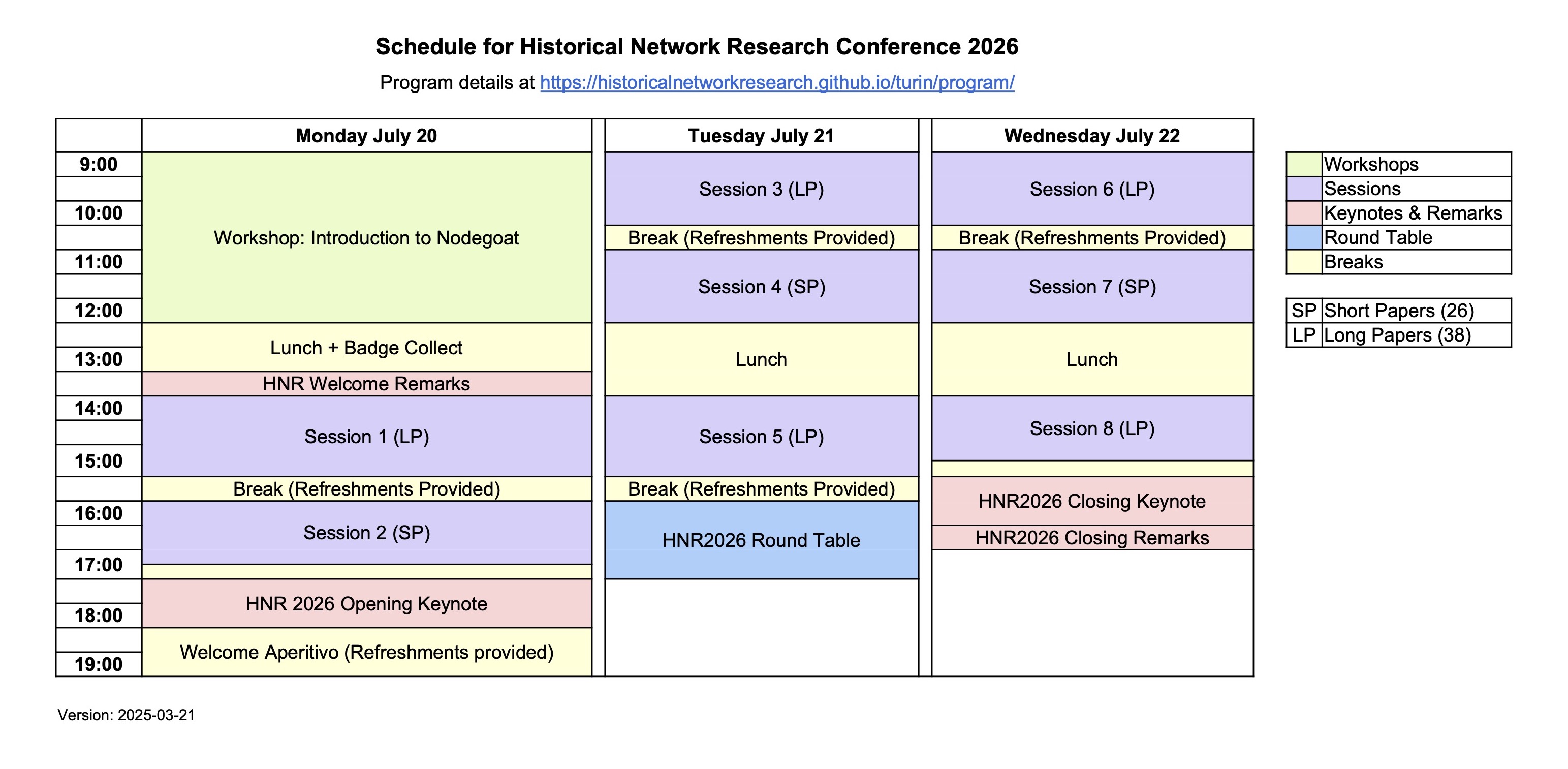
The program of the Historical Network Research Conference 2026 includes 38 long papers and 26 short papers (across 20 sessions), 2 keynotes, 1 round table, and 1 workshop. It will bring together colleagues from all continents. Attendance is free, but registration is required.
- Free conference registration here;
- Workshop registration is entirely separate from conference registration, register for Nodegoat workshop here.
The book of abstracts will be published on June 1, 2026.
2026 Conference Focus: Networks and their Sources
The 2026 edition of the conference will see a broad range (temporal and thematic) of papers embracing historical networks research, however the guiding conference theme is Sources: an exploration of their role in, and relationship to, historical network research.
Since the so-called network turn, formal network research has transformed scholarship across the sciences and humanities. Applied to history, it has expanded research methods, encouraged interdisciplinary dialogue, and opened new perspectives on both past and present. Yet historical sources remain challenging: they are often fragmented, incomplete, shaped by bias, or considered inadequate for network analysis.
This conference invites participants to reflect on how sources — whether people, books, ideas, organizations, archaeological remains, archival documents, artworks, or other forms of evidence — make network research possible and meaningful. This conference aims to foster debate on the opportunities and limits that sources present, while encouraging innovative methodologies and cross-disciplinary perspectives.
Speakers

Scott B. Weingart, Chief Technology Officer, Library of Virginia, co-author of The Network Turn (Cambridge University Press, 2020) and The Historian’s Macroscope: Exploring Big Historical Data (World Scientific Press, 2015). Scott Weingart will give the opening keynote, “Historical Source Criticism in the Network Turn”, reflections on how network thinking, source selection, and historical argument influence one another, and how awareness of that entanglement improves our scholarship.
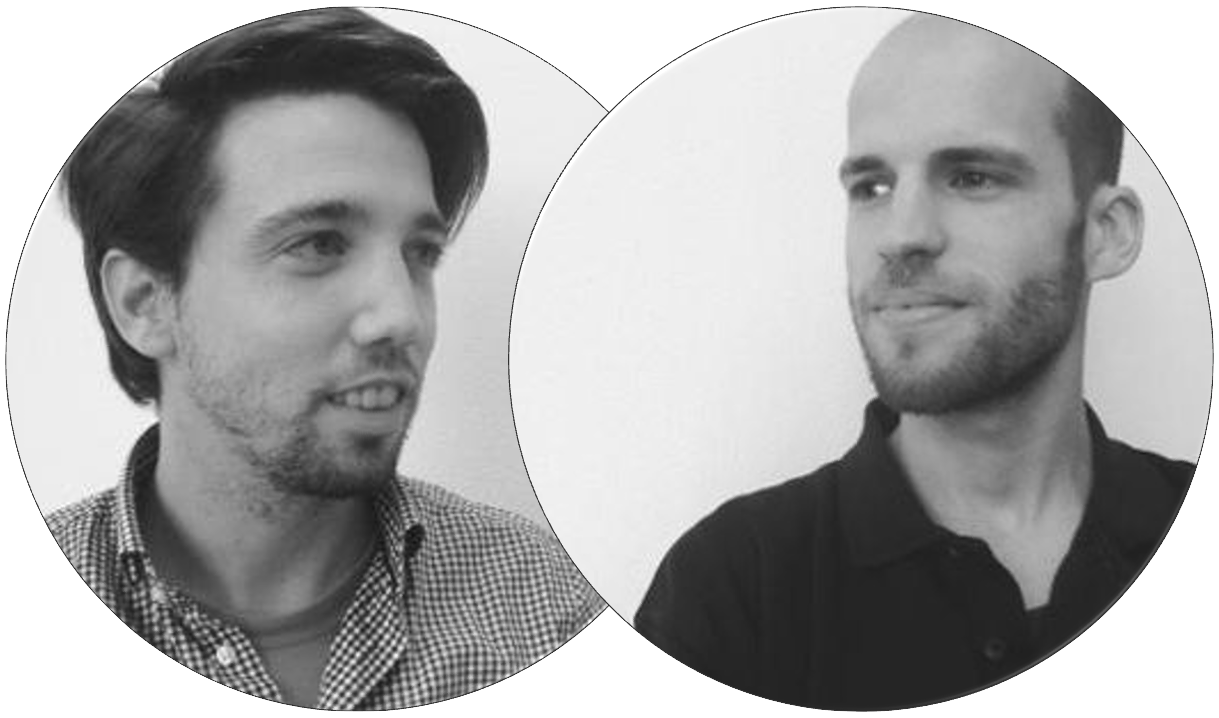
Pim van Bree and Geert Kessels, founders of nodegoat.net. The creators of integrated tools designed for research into historical networks, Pim van Bree and Geert Kessels will leading a free pre-conference workshop to demonstrate their potential. Registration is separate from the conference, see workshop registration details.
Closing keynote speaker and round table discussants to be aannounced mid-April 2026.
Monday 20 July
Monday 20 July will consist of workshops in the morning, a welcome address and the first paper sessions in the afternoon, concluding at the end of the day with the opening keynote. Registration for the workshops is independent of the conference: information and registration here.
9:00-12:00 WORKSHOP 1 – NODEGOAT
Aula S1
| Historical network analysis with nodegoat | Pim van Bree & Geert Kessels |
12:30-13:30 BADGE COLLECTION
Roman Wall
| Collect your badge and programs! | HNR 2026 Turin Committee |
13:30-14:00 WELCOME & OPENING REMARKS
Aula S1
| Welcoming remarks from the HNR2026 committee and the HNR Community Board | HNR2026 Organizers & HNR Community Board |
14:00–15:30 PARALLEL SESSIONS – LONG PAPERS
SESSION 1-A: Objects, Traces and Ancient Connectivity
Aula S1 - Chair: Tiziana Pasciuto
| From Connoisseurship to Networks: Mobilities of Potters and Painters in South Italy Red-Figure Pottery Production (450–300 BCE) | Marco Serino | |
| From Pyramid Town to Provincial Necropolis: Sources and Networks in Middle Kingdom Egypt | Danijela Stefanovic | |
| Historical Networks as Treasure Maps: Finding Relevant Sources with Aid from Attestation Networks | Lena Tambs |
SESSION 1-B: Testimony, Belief and Inquisition
Aula S2 - Chair: Jean-Paul Rehr
| Beyond Repression: Network Analysis and Social Dynamics in Medieval Inquisition Records | Roberto Mussinatto | |
| From Testimony to Network: Modelling Reported Interactions in the Bologna Inquisition Register (1291–1310) | Riccardo Katia, David Zbíral, Zoltán Brys, Robert L. J. Shaw | |
| Gender bias and endogenous dynamics of denunciations in shaping knowledge about the heterodox | Davor Salihovic, José Estévez |
SESSION 1-C: Women and Gender
Aula S3 - Chair: Alessandra Celati
| Gendered Knowledge Production in Romantic Correspondence Networks | Elena Suárez Cronauer, Aline Deicke | |
| Narrated Networks: Social Network Analysis of the Memoirs of Countess Luise Charlotte von Schwerin (1684–1732) | Selina Galka, Marcella Tambuscio | |
| Networks of Manuscript Production: Mapping Female Scribes and their Texts in Medieval Europe | Estelle Gueville |
16:00-17:15 PARALLEL SESSIONS – SHORT PAPERS
SESSION 2-A: Surveillance, Dissent and Control
Aula S1 - Chair: Margherita Criveller
| Constructing the Enemy: Network Analysis of Anti-Hussite Vocabulary in Late Medieval Diplomatic Correspondence | Aliaksandra Valodzina | |
| Investigating the Resilience of Waldensian Heterodoxy in Medieval Fribourg using Social Network Analysis | Stanisław Banach | |
| Networks under Surveillance: Source Bias and Historical Network Reconstruction in Revolutionary Iran | Misagh Javadpour Depretis | |
| Watching Your Back: Identifying Organization and Movement Counter-Surveillance via FOIA Requests (1989–1992) | Stephanie Zhang |
SESSION 2-B: Ancient and Medieval Connectivity
Aula S2 - Chair: TBD
| Clustering Lead White References Across Graeco-Roman Genres: Visual Network Analysis from a TheSu XML Dataset | Daniele Morrone | |
| From Sources to Networks: The TRACES Project and the Reconstruction of Mobility Systems from Antiquity to the Middle Ages | Caterina Paola Venditti, Cristina Corsi, David Gherdevich | |
| Exploring the Late Medieval Adriatic Wax Trade with Neo4j | Vladimir Aleksic | |
| Reassessing Ancient Connectivity in Central Italy from Fragmentary Sources: A Multiscale Uncertainty-Aware Network Model | Caterina Paola Venditti |
17:30-18:30 HNR 2026 OPENING KEYNOTE
Aula S1
| Scott B. Weingart opens HNR2026 with his views on the past, present, and future of sources in historical network research | Scott B. Weingart |
18:30-19:30 WELCOME COCKTAIL – APERITIVO
Roman Wall
| Complementary aperitivo to welcome HNR speakers and registered attendees |
Tuesday, 21 July
9:00–10:30 PARALLEL SESSIONS – LONG PAPERS
SESSION 3-A: The Circulation of Knowledge
Aula S1 - Chair: Alessandra Celati
| Nourished Among the Foremost Men: An Inquiry into Grosseteste's Intellectual Background | Matthieu Statius | |
| One Problem at a Time: Exploring the Network of Edo Japan's Mathematicians with Sangaku | Antonia Karaisl | |
| The BorGal Project: What's Next? | Federica Favino |
SESSION 3-B: Arts, Institutions and Actors
Aula S2 - Chair: Tiziana Pasciuto
| Navigating Institutional Archives of Suisse Romande Architecture Competitions | Clay Foye, Paul Guhennec | |
| Network Analysis for Historical Music Research: Deep-Mapping Musical Space in Milan (1958–1962) | Martin Nicastro | |
| Politics behind the Score: The Institutionalization of the São Paulo Municipal Symphony Orchestra | Breno Ampáro |
11:00–12:30 PARALLEL SESSIONS – SHORT PAPERS
SESSION 4-A: Machine Language and Historical Sources
Aula S1 - Chair: Jean-Paul Rehr
| From Bibliography to Network: Mapping the Contemporary Field of Leigh Hunt Studies (1987–2025) | Michael Sinatra | |
| Integrating Generative LLMs into the Study of Middle-Period Chinese Elites | Chen Song | |
| Metadata as Epistemic Devices: Towards Weak Semantic Networks in Digital Archives | Manfredi Scanagatta | |
| Reconstructing Early Red Cross Communication Networks: LLM-Assisted Analysis of the Bulletin International (1884–1914) | Riccardo Aramini | |
| Strings that Tie: Network Modeling and Interactive Visualization of Musical Instrument Makers in Valdrighi's Nomocheliurgografia | Federico Filippi Prévost de Bord |
SESSION 4-B: Correspondences
Aula S2 - Chair: TBD
| Caesurae and Continuities: A Qualitative-Quantitative Analysis of a Correspondence Network between 1882–1926 | Manuel Schmidinger | |
| From Letters to Networks: Historical Network Analysis of Dutch Brazil through the ePistolarium | Marlon Alcantara | |
| Reconstructing Visibility through Archival Sources: Grazia Pierantoni Mancini's Epistolary Networks | Aurora Sturli | |
| St. Petersburg Literacy Committee: Bipartite Networks of 1885 Correspondence | Anna Britanova, Artem Petrov, Iuna Minnubaeva |
14:00–15:30 PARALLEL SESSIONS – LONG PAPERS
SESSION 5-A: Communities and the Archive
Aula S1 - Chair: Tiziana Pasciuto
| Hidden Voices in the Archive: African Agency and Missionary Networks in Gold Coast | Pietro Fasola | |
| Mapping Academic Exile: A Multi-Layer Network Model of German Refugee Scholars in Türkiye (1933–1955) | Seyma Aksoy | |
| The Voice and Networks of Soybean-Pioneers in Austria since the 1950s | Gabriel Tober |
SESSION 5-B: Print and Media Networks
Aula S2 - Chair: TBD
| Echoes from the Periphery: Modelling Media Networks of the 1969 Apollo Landing in Authoritarian Portugal | Rafael Prezado | |
| Visual Network Analysis of Flemish Literary Periodicals (1966–1969): Tracing Literary Dynamics Beyond the Establishment–Underground Dichotomy | Jan Lampaert |
SESSION 5-C: Discovering Networks in the Sources
Aula S3 - Chair: TBD
| Co-Mention Network Dynamics in 20th-Century Anglophone Philosophy | Gregor Bös, Felix Gaisbauer | |
| Entries to Networks: Transforming Biographical Dictionaries into Knowledge Graphs with LLMs | Raphael Schlattmann, Aleksandra Kaye, Malte Vogl | |
| Textual Networks of St. Venceslas: The Application of HTR and LLM Tools to Church Slavonic Hagiographical Sources | Olga Kalashnikova |
16:00-17:30 HNR 2026 ROUND TABLE – CHALLENGES IN HNR AND ITS SOURCES
Aula S1
| A round table discussing Scott Weingart's opening keynote | Scott B. Weingart and discussants (names forthcoming) |
Wednesday, 22 July
9:00–11:30 PARALLEL SESSIONS – LONG PAPERS
SESSION 6-A: Detecting Communities in Historical Sources
Aula S1 - Chair: Aliaksandra Valodzina
| Filtering the Emperor: Communication Networks around Maximilian I (1459–1519) | Marcella Tambuscio | |
| From Mentions to Modularity: Co-Occurrence Networks in Ancient Greek and Latin Texts | Evelien De Graaf, Julie Nijs | |
| The Invisible College of Medicine in Jagiellonian Courts: The Network of Giovanni Manardo's Medical Letters | Cihan Şimşek |
SESSION 6-B (Long Papers): Migration and Mobility
Aula S2 - Chair: TBD
| A Spatial Network Study of Itinerant Performers' Passports in 18th- and 19th-Century France | Martin Grandjean, Johanna Daniel | |
| From the Alpine Woods to Transylvania: Emigration of Italian Forestry Workers to Austria-Hungary (1850s–1914) | Vincenzo Colaprice, Csongor Jánosi, Claudio Lorenzini | |
| Tracing Multi-Religiosity and Interethnic Networks among Iranian Communities in the Red Sea (19th–20th centuries) | Sara Zanotta, Tiziana Pasciuto |
SESSION 6-C (Long Papers): Culture and the Cold War
Aula S3 - Chair: Margherita Criveller
| Bankers, Businessmen and the Cultural Cold War: Networks of Transatlantic Cultural Associationism | Giulia Clarizia | |
| Mapping the History of European Nuclear Fusion Cooperation: Combining Archival and Publication Data | Malte Vogl, Roberto Lalli | |
| Weaving Influence: Network Dynamics of U.S. PL-480 Food Aid in Morocco during the Cold War (1957–1965) | Hanane Haichami |
11:00–12:30 PARALLEL SESSIONS
SESSION 7-A: Explorations in HNR — Short Papers
Aula S1 - Chair: Alessandra Celati
| Modeling Fragmented Prosopography: Historical Network Analysis and Archival Constraints in the 16th-Century Greek Community of Venice | Eleni Makrygiorgou | |
| Networks of Order: How Austria Reconstituted Power in 1848 | Dimitra Grigoriou | |
| Networks of the Social Question: Republican and Catholic Reformers in Belle Époque France (1890–1920) | Tommaso Giordani | |
| The Material Network of Empire: Household Objects, Sociability, and Mobility in Colonial India | Rohini Panicker |
SESSION 7-B: Technical Challenges in Historical Networks — Short Papers
Aula S2 - Chair: Margherita Criveller
| Hurry Slowly: The Jesuit Catalogs Database and Obstacles to Automation | David Thomas, Alessandro Corsi | |
| Researching Historical-Biographical Information in Digital Scholarly Editions through Event-Oriented Affiliation Networks | Timo Frühwirth | |
| Studying News Coverage through Embeddings Networks: Opportunities and Challenges for Historical Research | Martin Grandjean | |
| The Feature Networks of High Medieval Writing | Celis Tittse | |
| Unveiling Sentiment Weighted Network Analysis (SWENA) with ERGM in Ottoman-Turkish Memoirs: A Hybrid Causal Analysis | Mustafa Ilter |
14:00–15:15 PARALLEL SESSIONS
SESSION 8-A: Print Culture and Information Flow — Long Papers
Aula S1 - Chair: TBD
| Press, Power, Links and Public Spheres: Newspaper Networks in the Grand Duchy of Finland, 1867–1878 | Aytaç Yürükçü | |
| The Flow of Information in European Book Publishing, 1500–1800 | Peeter Tinits |
SESSION 8-B: Trade and Commercial Exchange — Long Papers
Aula S2 - Chair: TBD
| Disclosing Counterfeit Networks: The International Association of Museum Officials in Defence Against Counterfeiting and Improper Trade Practices, c. 1900–1945 | Jaap Geraerts, Demival Vasques Filho | |
| Harmonizing Historical Trade Using Geopolitical Data: A Multilayer Network Approach to Bilateral Flows, 1830–1938 | Paul Girard, Béatrice Dedinger, Guillaume Daudin, Youssef Ghallada |
SESSION 8-C: Medieval Material Culture in Circulation — Long Papers
Aula S3 - Chair: TBD
| Mapping Monastic Networks: The TITULI Project and the Circulation of Medieval Mortuary Rolls (8th–16th c.) | Davide Gherdevich | |
| NOMISMATA: Exploring Numismatic Networks Emerging from a Source-Driven Database | Giorgio Donato, Pim Van Bree, Geert Kessels |
15:30-16:30 HNR 2026 CLOSING KEYNOTE
Aula S1
| Subject and speaker to be announced mid-April | Speaker TBA |
16:30-16:45 HNR 2026 CLOSING REMARKS
Aula S1
| CLosing remarks from the HNR2026 committee and the HNR Community Board | HNR2026 Organizers & HNR Community Board |